Volunteer Plants
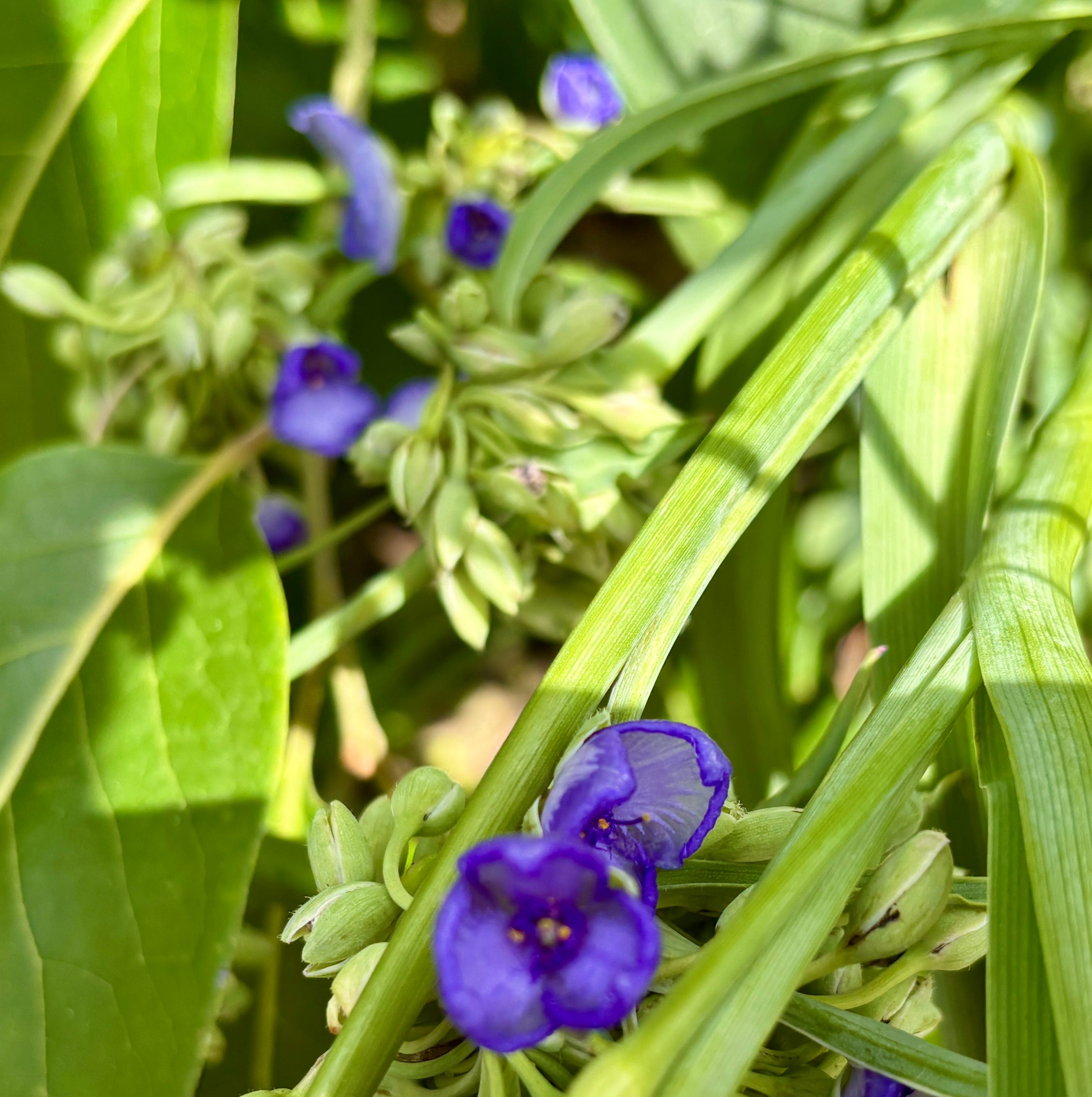
“Volunteer” is a lovely term of art. In horticulture, it refers to plants that propagate themselves and grow without human intervention, but, unlike weeds, are desirable to the gardener. Sometime last year, spiderwort plants appeared in the small box garden in front of my house, specifically the Ohio spiderwort (Tradescantia ohiensis) a lovely purple flower common throughout the American East and Midwest. In settled areas, spiderworts are typically in fields and thickets along the roadside, or in more heavily disturbed areas such as along railroad tracks. The box garden certainly qualifies as disturbed. I dug the area up completely in order to plant an American persimmon tree (Diospyros virginiana) along with some beebalm cultivars (various Monarda) and butterfly weed plants (Asclepias tuberosa). The spiderwort came as a bonus.
I love the term “volunteer” as it implies some sort of civic culture among the plant kingdom, as if the spiderwort, sensing that I was trying to restore a bit of the native vegetation, decided that it would be best for the local ecology to propagate itself along with my other plantings. I appreciate the help. Spiderwort blossoms are comically small compared to its tall growth habit. Luxuriant foliage conceals the stray fast-food wrappers and ecommerce parcel boxes that, whenever a summer thunderstorm passes through, are knocked out of our neighbors’ trash cans and come flying into yard, settling in among the more naturalistic features of the neighborhood.
Costly Signaling
Writers often practice their art as an exclusive faith, as if their art, unlike, say music, were the only way of communing with a higher form of beauty. The figure most emblematic of this tendency, at least in my experience, the one who always comes to mind, is Gerald Murnane. He has not, as he takes pains to say, watched a movie or seen a television show or attended a visual arts exhibition in more than half a century. This rigor is reflected in the compositional quirks of his fiction. He avoids direct quotation and other features that bear a resemblance to film scripts. I wasn’t surprised to learn, then, that he once considered becoming a Catholic priest, had briefly studied to become one. His writing can resemble a catechism, doctrinal instruction, for initiates into the cult of the written word.
As a writer who takes a lively interest other artforms, I find these strictures baffling—not in the case of Murnane himself, who has produced a distinctive and beguiling body of work—rather, I find these strictures baffling and, honestly, irritating, when professed by those who don’t have Murnane’s commitment. There is a certain kind of writer, or rather, a certain kind of aspiring writer (poster) who habitually frequents Twitter or Bluesky or Substack (whatever the social media platform de jour might be) and who professes, despite what their screen time might indicate, a single-minded devotion to writing, sometimes even citing Murnane on the subject with approval.
It’s true that many, perhaps most writers (aspiring and otherwise) waste their time browsing social media or playing video games and so forth. I can’t say, not with any honesty, that I’m exceptional in this regard either. A quasi-religious avoidance of contemporary media, even in the form of a weekly sabbath, yields results, even from a standpoint of pure productivity. In any case, devotion inspires devotion. The economistic term for this is “costly signaling”, where individuals perform behaviors that impose significant personal costs to credibly communicate their underlying intentions. The theory goes a long way to explaining why theologically conservative religious groups continue to attract members while liberal groups, ostensibly better equipped to handle modernity, continue to decline. Devotion requires to devotion.
The problem with would-be followers of Murnane is that fiction writing, at least as its currently conceived of, is an individual endeavour and that anyone following in his footsteps might very well be obscured in his shadow. But I really was, however, moved by the devotional atmosphere found in Murnane’s work, especially A Million Windows. In that book, half novel, half thesis of literary art, the practitioners of what he calls “true fiction” live in a sort of monastic seclusion at the edge of the plains, where they, in accordance with their vocation, gaze out from a literal million windowed building onto a gently rolling grassland, searching for intimations of eternity within that pastoral landscape and turning away, scrupulously so, from corrupting innovations of film and television.
I find the novel’s atmosphere charming but am too heterodox in my disposition to live there permanently. I like going to the movies, even like playing some video games when I can. I know that that very basic pattern of life (by definition mediocre) is not likely to elicit any sort of cult-like devotion, but then again I’m uncomfortable with pretending to act otherwise. The strictures of A Million Windows certainly can’t be propounded by anyone (not least myself) who involves himself in tendentious online literary discussions and silly battles over clout. The reason why Murnane is so convincing, at least to his online fans, is because he isn’t. You won’t find him on social media. Outside his books, you won’t find him anywhere but rural southeastern Australia. Whether you conceive of what he does as mere “signaling” or something with a higher purpose, it would be absurd to question his professed convictions. The very concept of him using a smartphone is a novelty. But that is what it takes to have these writerly exhortations against contemporary culture have any weight to them whatsoever. You certainly can’t post your way to paradise, let alone any kind of monastic seclusion.
Electric Insect Graveyards
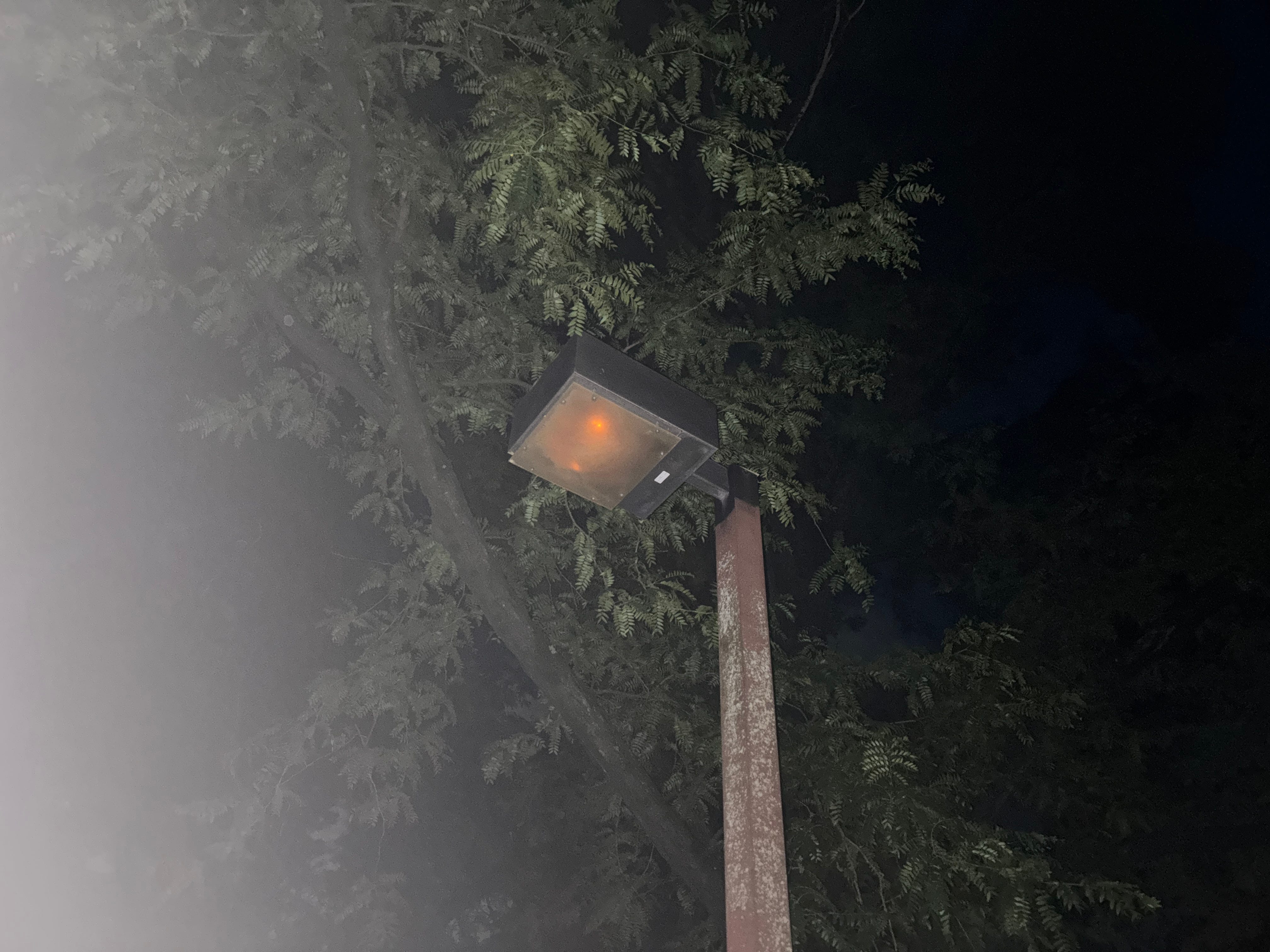
Firefly season continues, and, in places, hidden in the shrubbery, the buzzing of cicadas can even be heard. But the sweetest noise—the sweetest hum, thrum, whirr, or buzz—is the almost broken park streetlamp, flickering on and off, buzzing loudly with its—(rarest of all) a sodium bulb, a sodium bulb, not the harsh light of an LED. The lamp buzzes, first softly, then an overwhelming strength, and then with a weakness that is moving, as if in its stamped aluminum superstructure as sucked within itself the billions of ensouled creatures who are born, who live, and who die within a single season on the Eastern Seaboard.