Announcement: Some Essays and Vaucanson’s Canard
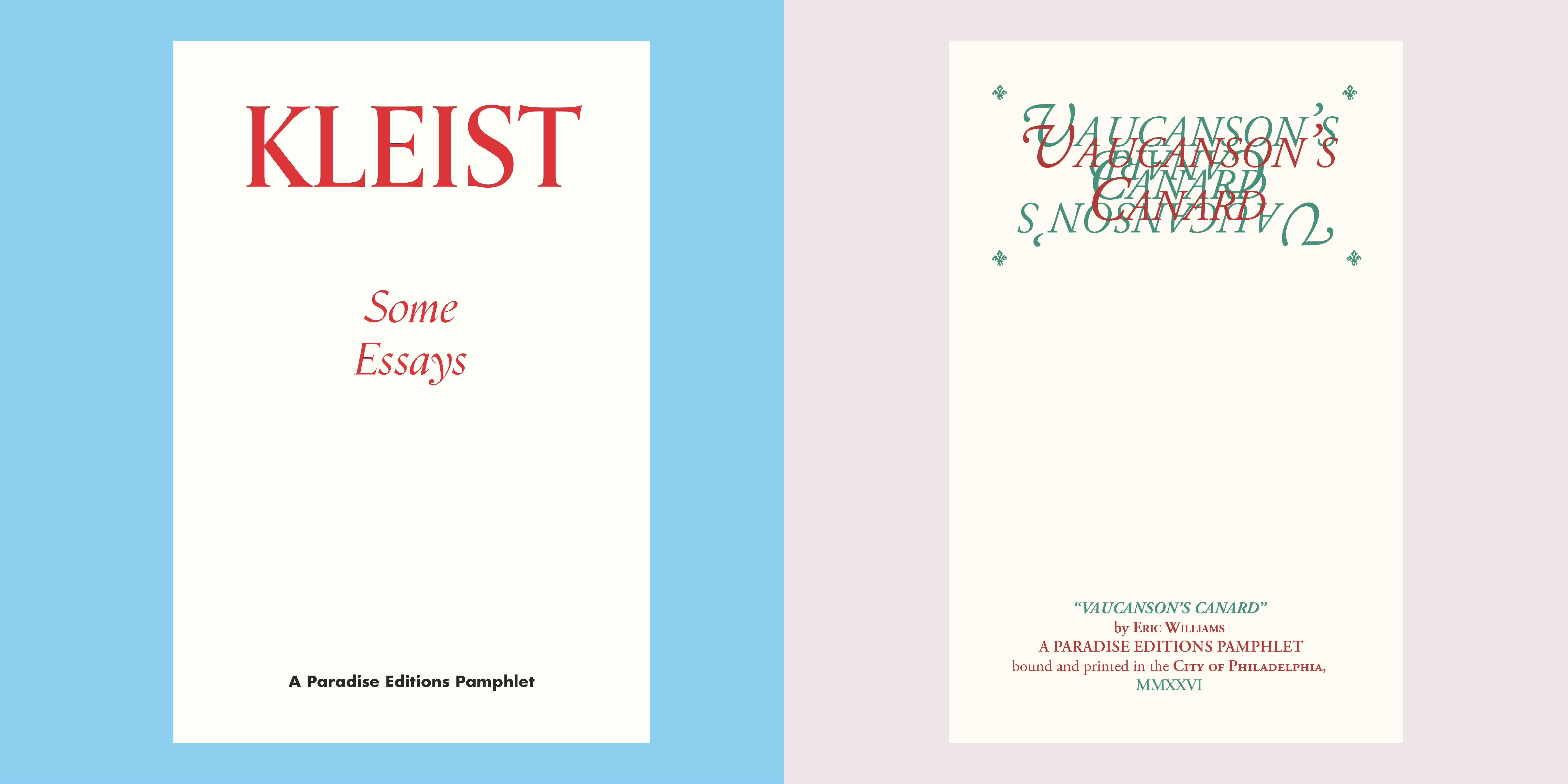
My press, Paradise Editions, has two pamphlets slated for imminent release. The first is a reprint of Some Essays, a collection of miscellaneous prose by Heinrich von Kleist, translated by me. Here’s a description:
Can a work of art reject its viewer? What if human beings have no control over their actions? What if recognizing this was the key to absolute freedom? These are some of the questions posed by Heinrich von Kleist in this collection. Published in rapid succession during the last year of his life, these brief but challenging essays present the finest distillation of Kleist’s thoughts on art, history, and philosophy.
28 pages, 5.5 x 8.5 inches, with a hand-sewn binding, laser printed on premium “Berrylicious” paper by French Paper with a semi-transparent vellum inner cover. Edition of 199.
The second release is Vaucanson’s Canard, a pamphlet containing an original short story by Eric Williams with typesetting and photocollage by me. You might know Eric as the editor of Night Fears, a Paradise Editions anthology of translations that originally appeared in the pioneering pulp magazine Weird Tales. If you liked that book, you’ll find much to enjoy in The Canard.
Enlightenment France’s foremost artificer seeks to reproduce in clockwork the intricate lifeforms he sees around him—in other words, a mechanical duck. It can digest, seemingly; it can defecate, seemingly. Is Vaucanson’s work an affront to God? An homage to Creation? Or is it something that no one could have ever anticipated?
24 pages, 5.5 x 8.5 inches, with a hand-sewn binding, laser printed on premium “Insulation Pink” paper by French Paper with a semi-transparent vellum inner cover. Edition of 199.
Both the pamphlets are available together, at a discount, as the “Automaton Bundle” because of that shared subject, broadly constituted.
Sleeping the Day Away
Early last week, I fell asleep, accidentally, for around fifteen hours, fifteen hours give or take, from Monday night to Tuesday evening, having gone to bed a little bit before midnight and not waking up until the sun was already setting again. Having no kids and being a freelancer and sole proprietor by trade, I didn’t miss any pressing obligations, but the lost time still stung, stung more than if I had wasted it in a conscious state. I’ve wasted a lot of time in my life and this felt much worse.
Unlike many of the annoyances and difficulties in my life, the oversleeping was not, I don’t think, a symptom of my kidney stones, which have stubbornly persisted despite surgical intervention. In this case, it might have been from the store-brand naproxen sodium analgesic I’d taken before bed. I’ve had negative side effects from the drug in the past, namely drowsiness, but since I was going to sleep, was planning on sleeping,—sleeping a normal amount,—I figured that this would be a non-issue. But despite sleeping fifteen hours, give or take, I woke up still drowsy, as if I hadn’t slept at all, and had to force myself not go immediately back to bed again.
At times like these, following various chaotic health-related events in my life, I feel a great deal of frustration, frustration not only at the loss of time but also at being driven, by those events, into the cliche-ridden territory of “the chronically ill”, a term that I despise, though it is, objectively speaking, the best descriptor of my life right now. It describes me having to put off necessary tasks—such as business tax filings or vacuuming the stairs or writing promotional social media entries—because I slept for fifteen hours, without waking up once, not even to go to the bathroom or have a drink of water.
Even worse, this state of affairs forces me adopt a policy of “being kind to myself” since the nature of chronic illness makes it difficult to maintain any kind of regular schedule. But that only deepens the frustration, since concepts such as being kind to oneself are freighted, possibly by their very nature, with such that same abject, cliché-ridden sentimentality I would rather avoid, to the point that I often wish to be cruel to myself instead, out of pique. But that would only, if anything, result in me having a even less of stable life than I have already.
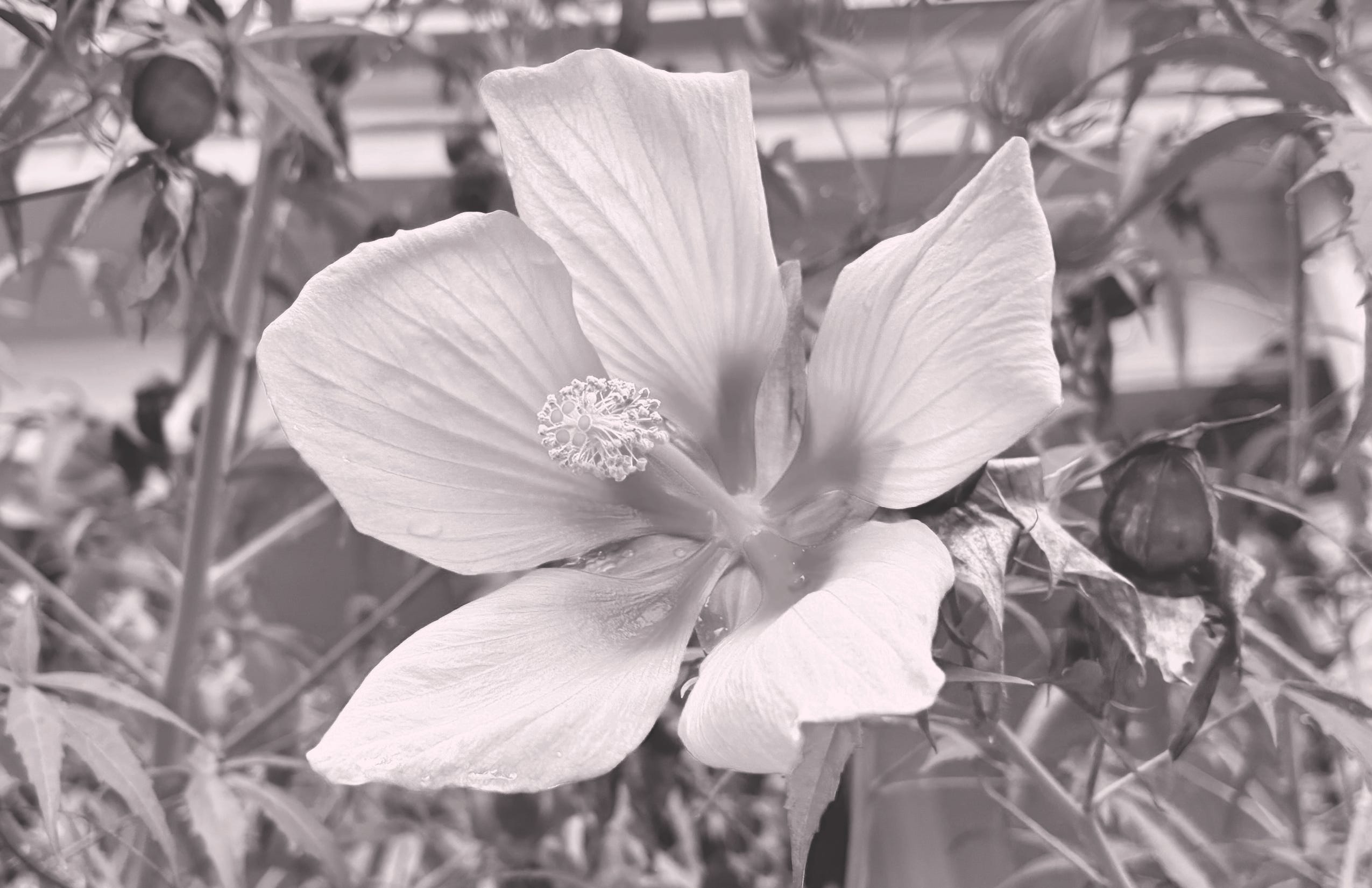
Despite those frustrations, I do think I have a good life, all things considered. And more than being kind to myself, it helps to get out and take a walk, when I can, and enjoy an early fall weekday—in other words, enjoy the leisure that chronic illness affords me: taking in the crystalline air, sharpened with a frigid undertone, seeing the hibiscus and fall asters still blooming along the canal footpath, the native passionflowers loaded with fruit—or, if I’ve slept through the day entirely, take a nighttime stroll, with a sweater and a jacket, finally—and watch a night-raiding fox creep along the state highway, following him as best I can, from the colonial cemetery, around to the diner, and then to the public golf course, watching, along the way, the fireflies as they drop from the trees overhead onto the sidewalk, their bodies strobing gently, slower and slower, until they expire.
It would be interesting to live, as fireflies and other insects do, in discrete lifecycles, without ever experiencing another generation, without ever knowing parents or children, perhaps not even having a concept of parents and children as individuals, only abstractions, their lives as untouchable, as unaccountable as some far-flung genetic ancestor. It would be a civilization of orphans, brought up in ruins, a civilization that always, inevitably, begins in the cradle and ends with the grave.
These are just some of the thoughts I had after sleeping for fifteen hours without meaning to.