

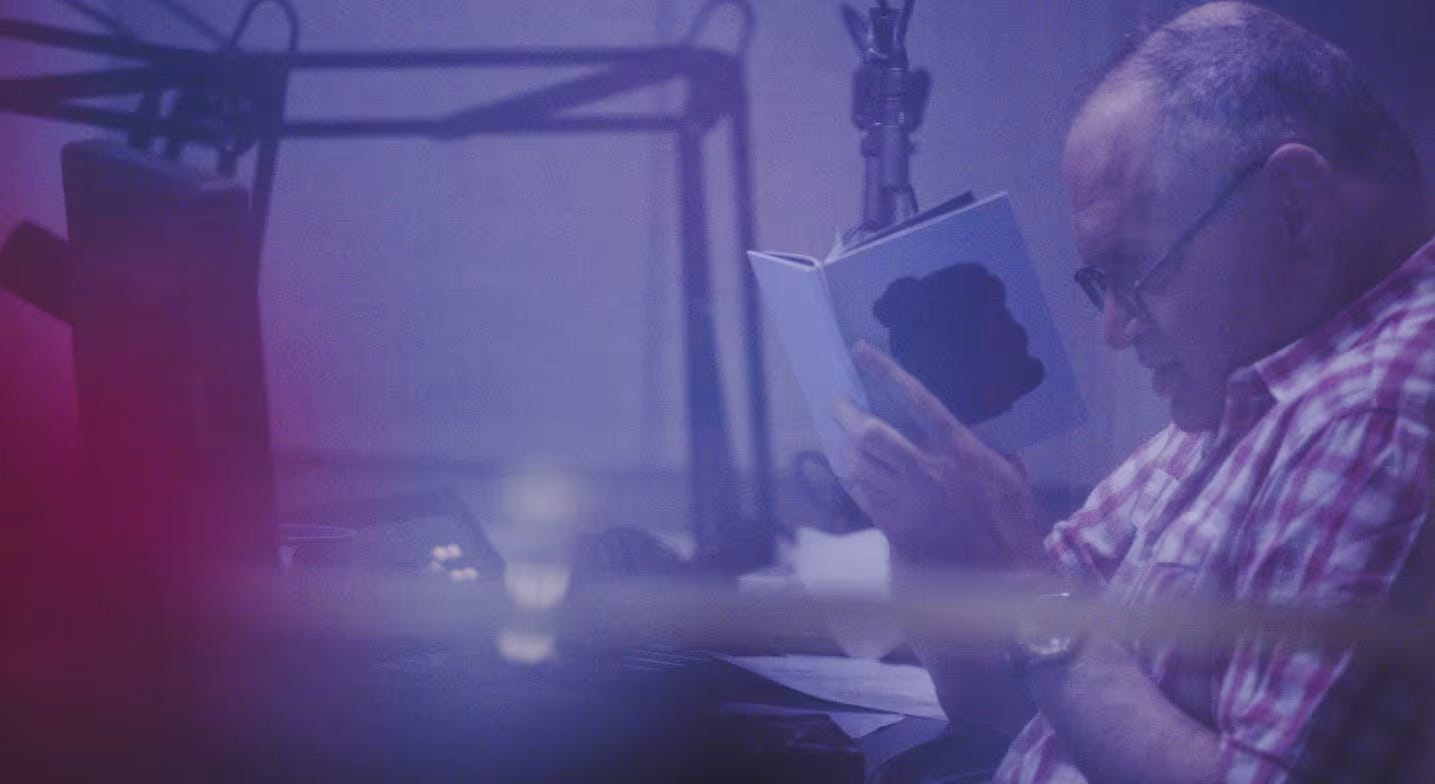
It began with nothing else but a soft gasp of recognition. My introduction to Michael Silverblatt (1952–2026) would have been on a late-evening or early-morning commute to the AAA Oregon roadside assistance call center. The drive-time listening consisted of an amalgam of NPR news broadcasts, podcasts of NPR news broadcasts, and CD-Rs of various obscure and obnoxious underground musical genres—ambient noise, noise rock, noise whatever. It was in that context that I discovered Bookworm, which broadcast from KCRW in Los Angeles from 1989–2020.
Despite its reputation as a hipster mecca, Portland in the 2000s was a provincial place, especially where literature was concerned, and Bookworm was a lifeline and an entrepôt for what an actual metropole had to offer, what college recruiters like call the life of the mind. In between taking calls from stranded motorists, I would improvise some sort of cultural scene with my peers, trading book and music recommendations. Despite the contemporary equation of coworker with dullard, they were never as philistine as management. The former would be game for the most outlandish recommendations. The latter would laugh at me to my face because I had never watched Little People, Big World.
I am not sure exactly when, but it must have been on one of those commutes that I first listened to Silverblatt’s interview with W. G. Sebald, an interview that planted the seed, or at least manured the soil, for my interest in German literature and translation. At the very beginning, Silverblatt asks Sebald about the influence of German poetry on his writing, citing Heinrich Heine and other well-known figures, a question which Sebald then redirects into an answer about the influence of German prose, citing writers that, despite my having taken the language in high school and community college, I had never heard of before, unlike, say, Heine. But Silverblatt evidently had heard of these writers. It’s when Sebald cites Adelbert Stifter as a key influence that he lets out that soft gasp of surprised recognition. I just had to know who this guy was. That second or so of airtime was material enough for a longstanding preoccupation.
Armed with the minimum-wage-plus-commission I earned at AAA, I would hunt for paperbacks at library sales and college-adjacent secondhand shops, hoping for a critical edition of Lenz or Bunte Steine, unbothered or at least undeterred by the cracked spine and smudged notes in the margins; the near unavailability of such books in the U.S. market salvaged them from what would otherwise have been an unsalable condition. Sources for an abandoned graduate thesis, castoffs from a retiring professor, these books became, through that Sebald interview, material for expanded consciousness. Through Sebald’s influences—through writers such as Gottfried Keller, Stifter, and Robert Walser—I could see how writers could refine workaday, provincial experience into something that, while not poetry itself, approached it in its beautiful rhythms and clarity of its images.
Later, when Anecdotes, my first book of translations, was published, I heard from my publisher that Silverblatt had read and enjoyed it. Of course, I nursed grandiose ambitions of going onto his program, of trading brilliant aperçus with contemporary literature’s most attentive reader. In hindsight, that was silly. Silverblatt had read and enjoyed thousands of books in his lifetime. He paid attention to my work because he was special, not the other way around. What I regret is not getting into contact with him just to express my gratitude. The world of serious literature is a small place and, provided you are not asking for a favor, quite accessible. If there is a living writer, a living critic, or just a living reader whom you admire, it is imperative that you get in contact with them, if only to let them know that their work is appreciated. This is how literary culture is maintained on a fundamental level. This fellowship is the work of a lifetime, but, as Silverblatt demonstrated every time he went on air, what a life and what a time.
Beautiful remembrance —thank you!
I've only just discovered Silverblatt's show now, in the days since his obituary was posted. It's an incredible archive, one of those things I think I'll be coming back to for a long time to come.