I have a new book out. It’s a translation of The Parson in Jubilee: An Appendix by Jean Paul, published through the Empyrean Series. Copies are available through my press’ website, Paradise Editions, as well as through my distributor, Asterism. This is the first time, since the novel’s publication in 1797, that it has appeared in English. A few years ago, I translated the preface for a Jean Paul anthology. And so, after the appetizer, now comes the main course:
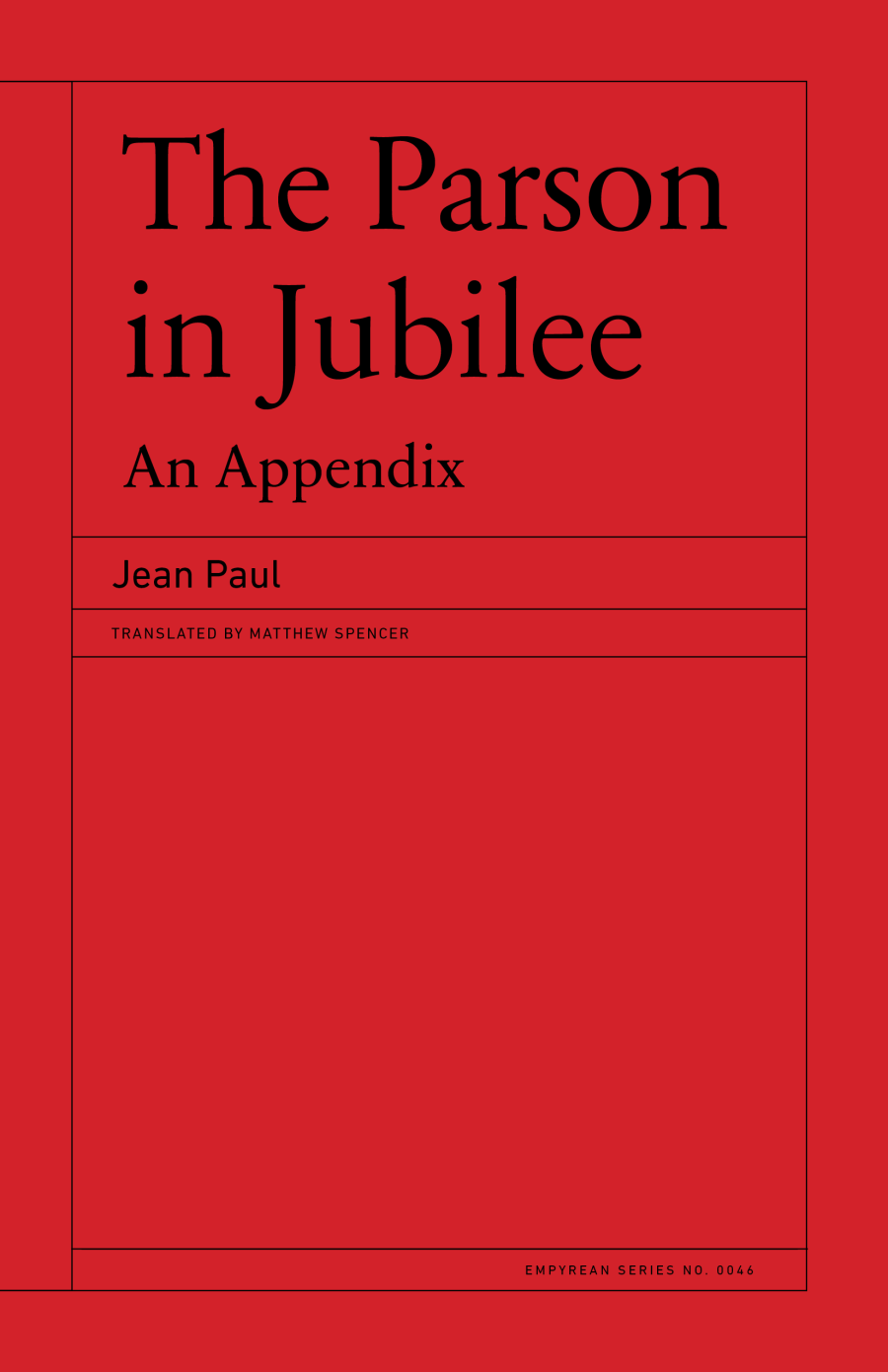
Here is how Empyrean describes the novel:
Declaring himself the inventor of a new literary genre—one which “explains little and banters much”—Jean Paul in The Parson in Jubilee: An Appendix (1797) portrays the joys and sorrows of the Schwers family on the eve of a momentous occasion: the double fifty-year anniversaries of the parson’s marriage and of his service to his village congregation. When a messenger arrives with a letter appointing the pastor’s son, Ingenuin, to the pastorship from which the father will soon retire, the romance between Alithea, the family’s adoptive daughter, and Ingenuin is starting to blossom. Through a series of “pastoral and encyclical letters”, Jean Paul presents the reader with an uproarious satirical complement to the book’s idyllic aspects. The book concludes with “The Appendix of the Appendix, or, My Christmas Eve,” one of Jean Paul’s most stunning and wondrous dream visions. Never before available in English, studiously annotated by translator Matthew Spencer, here is an irreverent, unclassifiable work from one of Germany’s most beloved and eccentric novelists.
As you can probably tell, The Parson in Jubilee is what a hack reviewer—(that critically endangered species, in need of our protection)—might call a “difficult” book, meaning that it’s formally inventive, with multiple changes in form, register, and perspective across its modest page count of 170 pages. But if the novel is “difficult” then Jean Paul wears that difficulty lightly. “Audacious” or “playful” might serve better, especially since play often requires serious effort on the part of the player. So let that word imply another word: fun
The stakes are low: just a simple country wedding and the anniversary of an old married couple. There is nothing “timely” or “necessary” about The Parson in Jubilee. It came out in 1797. Whether it is “luminous”, to use another book marketing phrase, depends on your appetite for JP’s antics. But low stakes are a prerequisite for free play. The score of a Harlem Globetrotters game is beside the point. It’s an exhibition game: no need to follow every move, let alone perform them at home. And, as I hope might be implied by the epithet of “studious”, I do try my best, like a tutor for a star college athlete, to do all the academic grunt work myself.
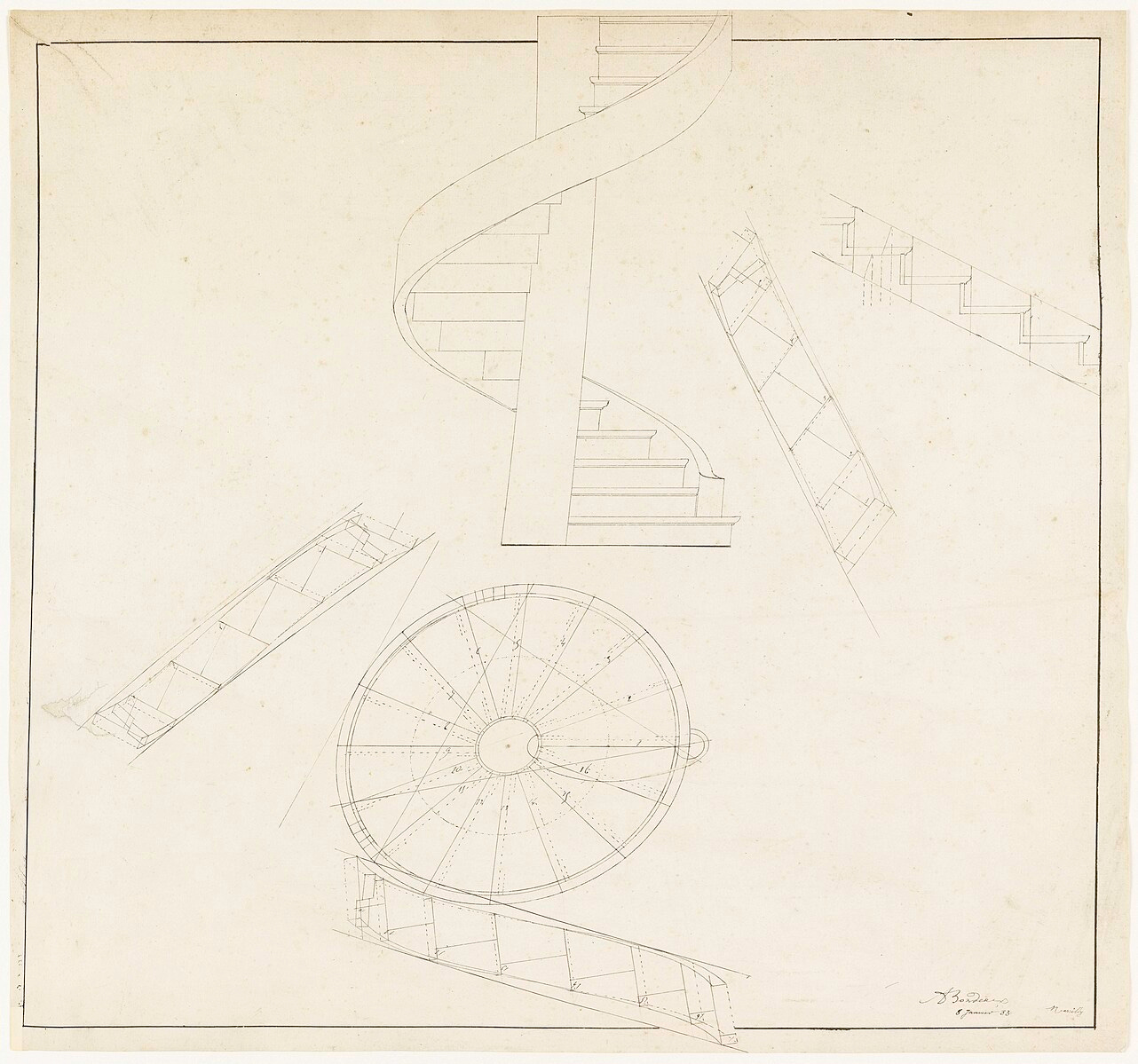
From the Shoproom Floor: Snail Staircase
For my social media posts about The Parson in Jubilee, I chose a passage for the first chapter, one that really exemplifies, at least in my mind, that classic bantering style of JP. It concerns worldly ambition, specifically the worldly ambition of pastors, priests, and spiritual leaders of all kinds, and how such ambitions might be realized:
Of all the stairs that ascend to the pulpit, there is perhaps none more moldering and worm-eaten than the gradus ad Parnassum, scholarly discipline, this Jacob’s Ladder of dreams; to ascend, one may set the siege-ladder of coarseness, the gallows-ladder of simony, against the pulpit and run up—or clamber up on apron strings, or rise in the aerostatic machine of a relative—:in short, one climbs all stairs—even clandestine ones—faster than the snail staircase of merit.
I’m especially fond of that last phrase, “snail staircase…”, because it allowed me to make what might otherwise be a bad move for a translator: deliberately ignoring the direct equivalent and opting for a word that makes less sense. Strange mollusk-related connotations aside, “Schneckentreppe” just means spiral staircase in German. It’s not used as frequently as “Wendeltreppe”, but it’s far less rare than the hapax legomena—words that appear only once in a given language—that JP deploys liberally throughout his voluminous writings, The Parson in Jubilee being far from an exception.
But it is quite normal, or at least not outlandishly strange, to call a spiral staircase a “snail staircase”, at least in other European languages: “Escalier en colimaçon” in French; “Schodiště šnekové” in Czech; “Slakkenhuistrap” in Dutch. Even the Uralic outlier of Hungarian has such a word: “csigalépcső”. Had I been working in those languages, rather than English, I could have better preserved both the literal and metaphorical senses of the passage; I was disappointed to find out that Albert Béguin’s 1981 French translation doesn’t do that, but simplifies the last sentence to, “bref, par tous les escaliers, – les secrets, du moins, – on monte plus vite que par l’escalier du mérite.” This is quite ironic since many people assume, naturally enough, that Jean Paul wrote in French.
Anyway, rendering “Schneckentreppe” as “snail staircase” might be considered a clumsy move. Eliding the difficulty, as Béguin does, makes for a smoother reading experience, but I don’t think I would be translating JP well if every passage was easily and immediately intelligible. That’s a fool’s errand for such an author anyway. In any case, I believe it’s much closer to the original spirit of the writing to have this absurd image of a staircase purpose built for snails.
Meaning gets lost in translation. That can’t be prevented. What remains under our control as translators is how that meaning gets lost. I’m perfectly fine if “snail staircase” doesn’t evoke a spiral staircase in the mind of the reader. That emphasis is better placed on the slowness inherent in climbing the ladder of success through honest means. I’m sure every reasonable person can agree on that.