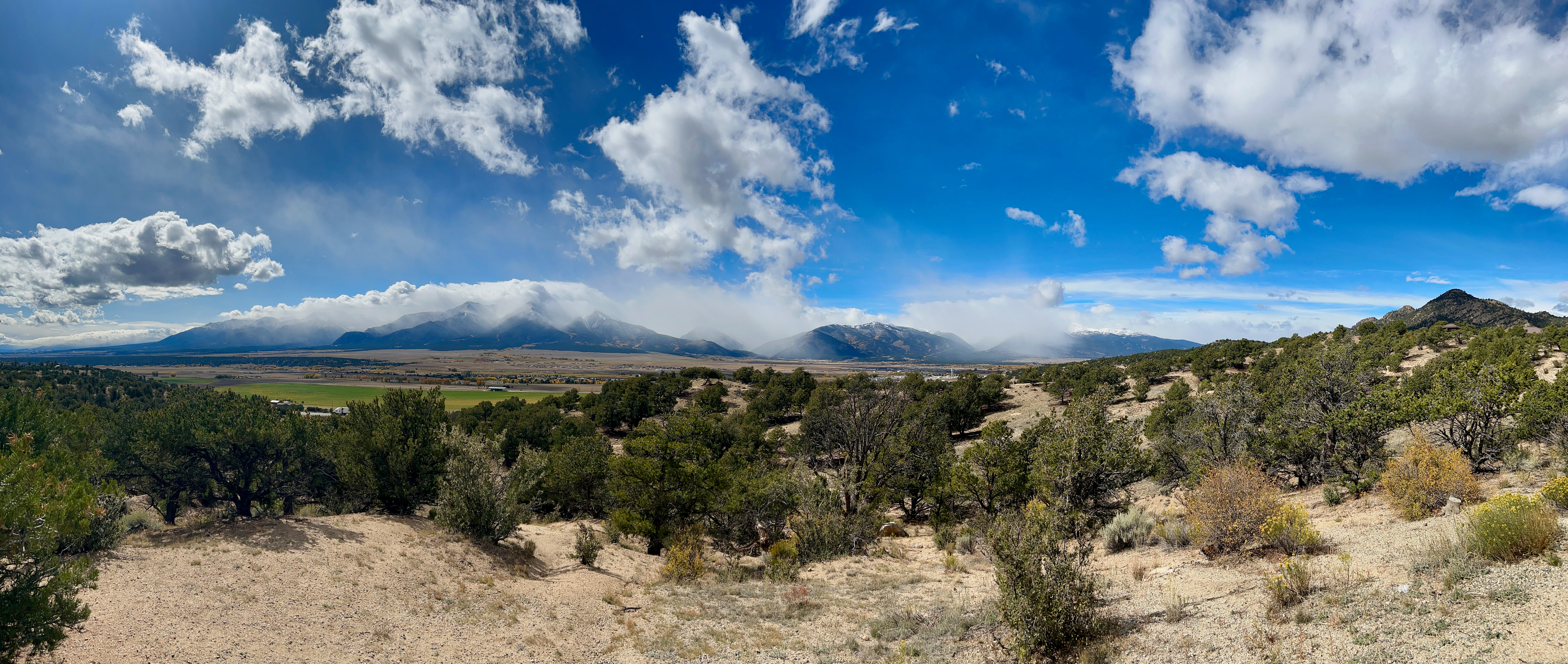
Glacial meltwater seeps between barren outcroppings. A vulture circles above the peaks. The blue horizon, fading into a hypobaric black, permutates into a steady tone, that will, in time, merge into larger currents, flowing toward the sea. A saint can take this in, the heights and depths of a world not yet disenchanted. He can be taken by it. He can put his head in the mouth of a demon. He knows that it all will dissolve. Birth, youth, misdeeds, meeting the guru, ordeals, practice, meditation, retreat, death, nirvana—events that color the tones, color a life, immensities swallowed up by even a larger immensity.
My thoughts were nowhere near as elevated at the tail end of January, when the Northeast was locked in a weekslong ice storm, my wife and I, having been cooped up too long in the house, took a walk to the local beer store. Despite the inclement conditions, the pavement slick with ice a local drunk (a drunk as yet unfamiliar to me) launching himself at the doors, banging on the windows, all to be let inside. The shop owner, dressed in a robe and slippers, came down from the apartment upstairs, and opened the doors for us. If had come a minute later, so the drunk, assured us, then he would have kicked the doors in. I must have made a face, grimaced or something, because he turned to me, and, after sizing me up, seeing my scarf and cowboy hat, said: “What the fuck are you looking at? You look like you’re from the Revolutionary War.”
There is, I think, a certain type of Philly person—a certain type of Philly lowlife if we’re being ungenerous—who associates anything old-fashioned with the American Revolution, but the hat I was wearing is more —the oil baron Daniel Plainview, played by Daniel Day-Lewis, in There Will Be Blood wears a similar hat, specifically a Western fedora. Mine was purchased for my sister’s wedding in the San Luis Valley of Colorado, which, coincidentally, has one of the highest concentrations of Buddhists in America. Analogous geography and celebrity philanthropists led to a group migration of Tibetan lamas starting in the 1970s.
There are no stories of saints like Milarepa in Colorado, at least as far as I know. Among the mining, ranching, and beer-brewing magnates of that state, Élaine Radigue would be hard pressed to find anyone that fit to inspire her devotional minimalist compositions, but the landscape of the Rocky Mountains is worth that, worth that certainly. It was the first inspiration of Radigue’s friend and collaborator La Monte Young—still alive at 90 years—who was born in a log cabin in Idaho. In both, we find tones stretched into geologic immensity. It was equation—landscape= music, music=landscape—that I lached onto immediately when I first encountered minimalist composition through bands like Earth and Sunn0)). Anything on a smaller scale didn’t really interest me.
As it happened, I was listening to a lot of Éliane Radigue before she died in February. The trip to the beer store turned out to be my last, at least for the foreseeable future, since the anticonvulsant medication I take for fibromyalgia interacts badly with alcohol—booze means problems. But, as it turned out, I didn’t necessarily need to mix beer with pills to feel terrible, since one of the other medications for fibromyalgia, Duloxetine, an antidepressant, triggered a dangerous drop in sodium levels, which left me delirious and racked with spasmodic pain. During that time, laid out on the floor of my home office—the only place quiet enough to sleep in my hypersensitive state—I would listen to Jetsun Mila on repeat.
I can’t say I was in a morbid, or even a reflective state of mind; more than anything I was annoyed by my compounding health problems. Radigue’s music was comfort during an illness, but not because of any spiritual theme, nothing about samsara, the Buddhist cycle of birth, suffering, death, and rebirth, but just a sentimental attachment to empty quiet landscapes, the kind that sit in the background of a Fredric Remington painting—the gold of aspen leaves, newly fallen snow—early in the autumn, or late into spring—and purple mountains—yes, they can be purple. More than any devotional importance, the steady, seemingly infinitely sustained tones of Jetsun Mila was a sop; I’m not sure if Éliane Radigue would have approved of such a use for her music, but am grateful for it nonetheless. It made downing glasses full of saltwater much easier. Thank you Éliane.