This essay is part of an occasional series where I recount my experiences in the hybrid micro-press/elevated self-publishing space I’ve occupied for a few years now. It was inspired by Isabel Pabán Freed reflecting on the same. Any editorial complaints can be lodged in the form of a paid subscription to her newsletter, linked below:

The office supply store, despite being part of a national chain, was not a place of smooth commerce, that much was obvious from the start. As I pulled into the lot, a man opened the sliding door of an unmarked ramshackle cargo van parked a few spaces away. He gave me a hard stare, then, after a dismissive shrug of the shoulders, slammed the door shut. My presence was disrupting some kind of business, shady or otherwise. I might have been more interesting had he known I was taking prescription opioids—not that I would have given him any.
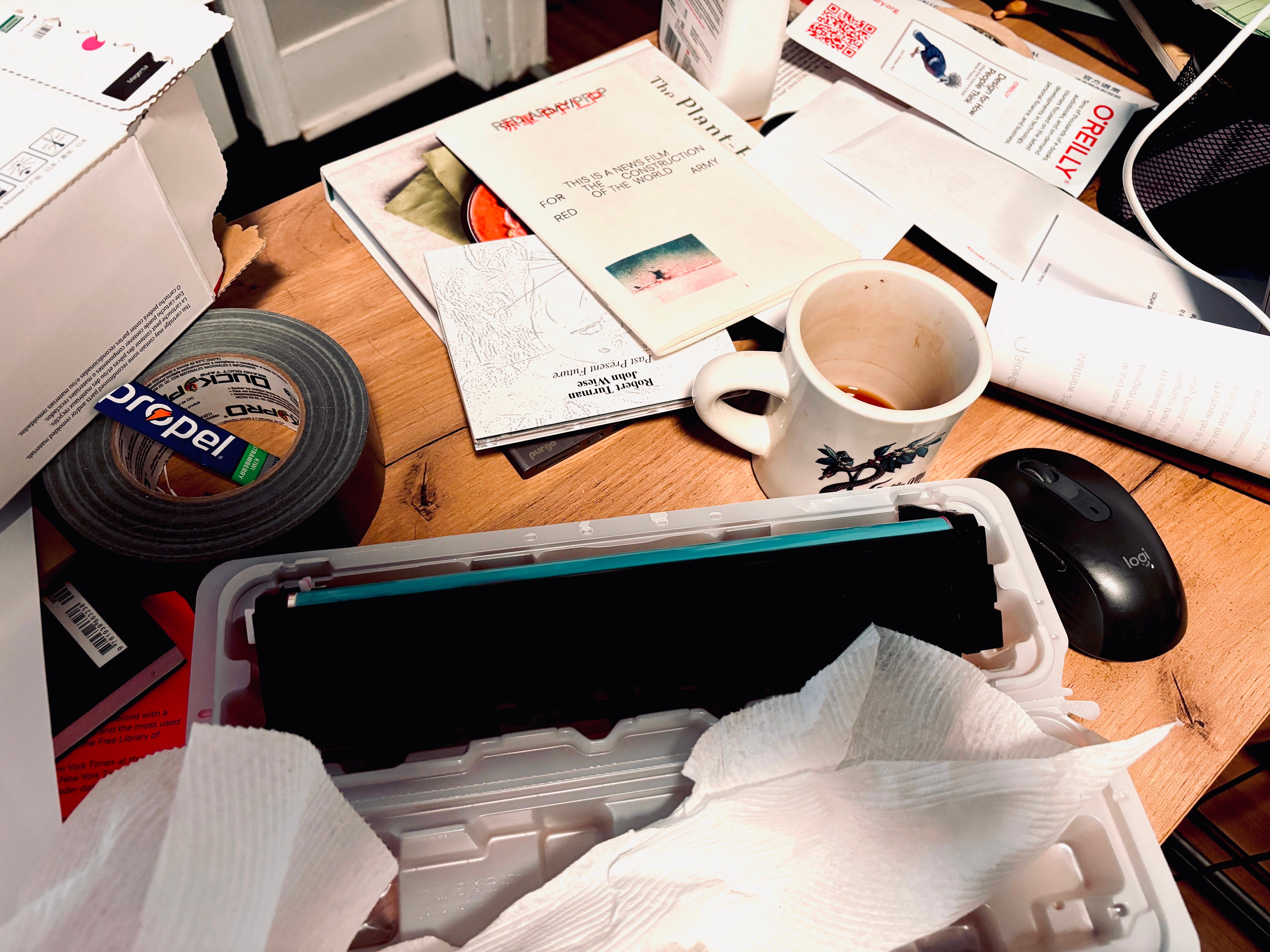
But there were other, more inviting signs of life in the vicinity. A bird had built a nest in the hollowed-out signage above the store entrance. Its droppings, along with a healthy supply of cigarette butts, littered the walkway. I would’ve liked to wait and maybe observe what species was nesting there—(from the round shape of the nest, it might have been a house sparrow)—but a wave of nausea and fatigue, brought on by combination of kidney stones and fibromyalgia, cancelled any urban birding I might have improvised for myself. I was nearing the limit of my capacity for the day. In addition to a toner cartridge breaking on me, spilling magenta pigment all over my hands and desk, I had also spent two hours in traffic earlier that morning, picking up my mother-in-law from the airport, and, for my trouble, was issued a parking ticket during the brunch afterward. I wanted nothing less than to be running errands, even if I was going to see a bird along the way. In all likelihood, the sighting would have been unremarkable.
The office supply store, by the standards of contemporary retail, was well-staffed, run by three men of apparently evenly spaced graduations between middle and old age—a man in his 50s, apparently, a man in his 60s, apparently, and a man in his 70s, apparently. All were in possession of full heads of very white hair and very pinkish skin, having not so much a sunburnt complexion as a scalded one, similar to the color a hand might take if it were held under a steaming bath faucet. The eldest retail associate greeted me as I stepped inside, greeted me but in the most procedural sense of the word. He had a slumped posture that made it appear as if he were perched on the edge of a stool even after he had stood up. “What can I help you with?” he said, a note of exasperation already present in his voice. “I need a magenta toner cartridge—mine broke this morning.” “What number?” “The printer model?” “No,” the associate said, the pitch of his exasperation rising somewhere between a 3rd and 5th interval, “the cartridge number. I need the cartridge number.”
I explained to him that I had forgotten to write the cartridge number down—the malfunction had happened around 7:30 AM—but I did manage to have the model number of the printer. I’d be able to tell from the box which cartridge was the correct one, right?…right? Grumbling, the associate conceded my point, pulled out his store-issued PDA, complete with plastic stylus, and tapped out the model number I gave him, enunciating every letter and digit as if he was, like me, slightly hard of hearing. Wanting to move the transaction along, I said “I might be able to look for the toner myself, if you could just tell me where it is…” That request seemed to trouble him even more than me failing to write down the cartridge number, and he began tapping furiously on the PDA, saying that I was “in for real trouble” because there was “…a lot of toner back there, so much toner” When I repeated myself, saying that I could manage on my own, the associate threw up his arms. “Well, it’s back there,” he said, “—way back there.”
What he meant by “back there” was the other side of the shelves that we had been standing at, less than a dozen feet from the store entrance. He shuffled over, waving for me to come along. He pointed with a jabbing motion towards boxes of cartridges. “Help yourself, help yourself—but I’m going to find it sooner.” I went through the toner, examining the boxes while the associate furiously rapped on the PDA with his stylus. After a minute or so of this rapping, he said he had found what I was looking for. He showed me the readout on the PDA. The screen was angled awkwardly; I couldn’t see the numerals. “It’s this one,” he said with finality. “Where?” “There, man—there, guy—it’s that one” I looked at the corresponding box. The cartridge was for magenta, that much was obvious, and the correct brand too, but the model number on the box did not match to the printer I had at home. I said so. The associate’s disdain was palpable: “They can’t possibly print all the model numbers on the packaging.” I examined the abundant white space on the box—in moment, his had been a sufficient argument; my own reasoning was motivated. I just wanted to go home and print out some pamphlets, print some author copies of a specific pamphlets, that I had promised to my friend and collaborator Eric Williams—that was reason I was trying to replace the toner that day. I was going to do that and then take a Tramadol; I was going to take a Tramadol and then take a nap; I was going to take a nap and then forget about the whole debacle.
But back in the car, my doubts about the retail associate and his advice were mounting. If I opened up the package, if I used the toner, then I wouldn’t be able to return it. And if something did go wrong, which seemed more and more likely, I wasn’t about the call any helpline or visit the retailer’s website or the manufacturer’s website either, not without the deepest trepidation. All that was going to get me were LLM agents and automated phone trees, which, despite their procedural agreeability, were almost certainly going to be just as helpful, just as immediately helpful anyway, as that retail associate. Glancing between the web browser on my phone and the bird’s nest inside the store sign, I reminisced about my last retail job, at a kitchen supply store in Seattle. There, I had been more than content, unlike the associate who had just assisted me, to direct people to the relevant section of the store and have them search out the products they wanted for themselves. Granted, both the clientele and the merchandise at the kitchen store were much more upscale—we sold to a mix of professional chefs and tech workers who wanted to emulate them—but as it happened, both stores were located in dilapidated buildings, to such an extent that, in 2019, just before the pandemic, the kitchen supply store, along with half the block, burned down, the result of a spark from faulty electrical wiring.
Luckily, this incident happened right as my wife’s career was taking off. She worked, and still works, “in tech”, but not in usual, paradigmatic way; she had risen in the ranks from customer service—software support, in her case—to project management, a career path that essentially no longer exists. Her entry-level position was one of those replaced by LLMs and automated phone trees. There was a time, a time not too long ago, when I could have called up someone like her, could have emailed someone like her, and had her help me through my toner problems. By luck and by talent, she—and me along with her—passed through the deskilling keyhole into a fairly comfortable life—to the degree that even my chronic health problems—(severe enough to devastate someone with slightly worse health insurance)—had become a kind of vintage accouterment, a token of old-fashioned bourgeois life, like having extramarital affairs or smoking pipe tobacco. I didn’t need to print out the pamphlets that day, not to survive in any case, only needed to print them out of a class-based sense of propriety—(everything must be kept in stock, orders needed to be fulfilled as soon as possible). Frustrated as I was with the office supply store and the retail associate, I should have felt lucky—as I do now—to be running errands out of a sense of propriety. In any case, I did return the cartridge. It wasn’t the right one.
Through no intervention of mine, I started feeling well on the drive home, well enough to stop at another, smaller office supply store, this one in a leafy, historic suburb very much like the neighborhood where I worked in Seattle. It had never suffered from the blight that consumed—and still consumes—so much of urban Philadelphia. At this office supply store, I quickly found the toner I was looking for. It took no more than a few minutes to be directed to the correct section and to the correct product. The retail associate at his other office supply store—descriptive details of whom I will, in this case, omit for reasons that will become obvious—was friendly but in a casual way that felt neither imposed nor insincere. Along with the toner, I also bought some ballpoint pens, and when the associate rang me up and asked, “just these two things?”, I was pleased to see that he had only scanned the pens, saving me about a hundred dollars in the process. I can’t be sure what he thought of me and things that I had bought, but I was certain that he hadn’t rung up the toner on purpose.
For my part, I’d like to think that he did what he did because he felt he knew where I was coming from. Where I was coming from, where I had come from, was where he was right now. I didn’t need to have that kind of job anymore, but in the somewhat distant past, I actually did; and because of that possible, hypothetical understanding, he made my life easier in a nontrivial way. If he had been caught, either by store surveillance or by me disclosing even what could fairly be supposed a mistake, he could have lost his job—not the most likely case, but nevertheless one that still had a nontrivial chance of happening. It appreciated it. “I appreciate you, man,” I said. It was a transaction, it was a commercial exchange free of the hectoring American mindset that puts the bottom line of monopolistic conglomerates above all other considerations, whether they be moral and aesthetic; it was transaction performed, strange as it may sound, with a kind of grace, a grace that’s become rare these days. You really don’t see it that much anymore.
The catch was that, while appreciated, the gesture was also unnecessary; I wasn’t hurting for money. I was using the toner for what could very well be considered, at least in a financial sense, a hobby business. Unlike the middle-aged to elderly men working at the other office supply store, I could, I still can, stop making books and pamphlets at any time. And, if I’m being honest with myself, the motivation to continue making books and pamphlets doesn’t stem, or doesn’t stem very much, from any driving artistic ambition, not that alone at any rate, but rather that anachronistic sense of bourgeois propriety. How should I be spending my time as a sickly person? By lying on the couch and playing Resident Evil? By watching Tony Scott movies? I do do those things too, but if I do them for too long, then I can’t square it with my Presbyterian upbringing. I won’t go so far to say that the hand of providence is behind the luck that I’ve had in this life, but I am trying to live as it were the case; not only for myself but for those from whom chance, or whatever you might to call it, hasn’t been as kind. If that’s bourgeois propriety, then so be it.