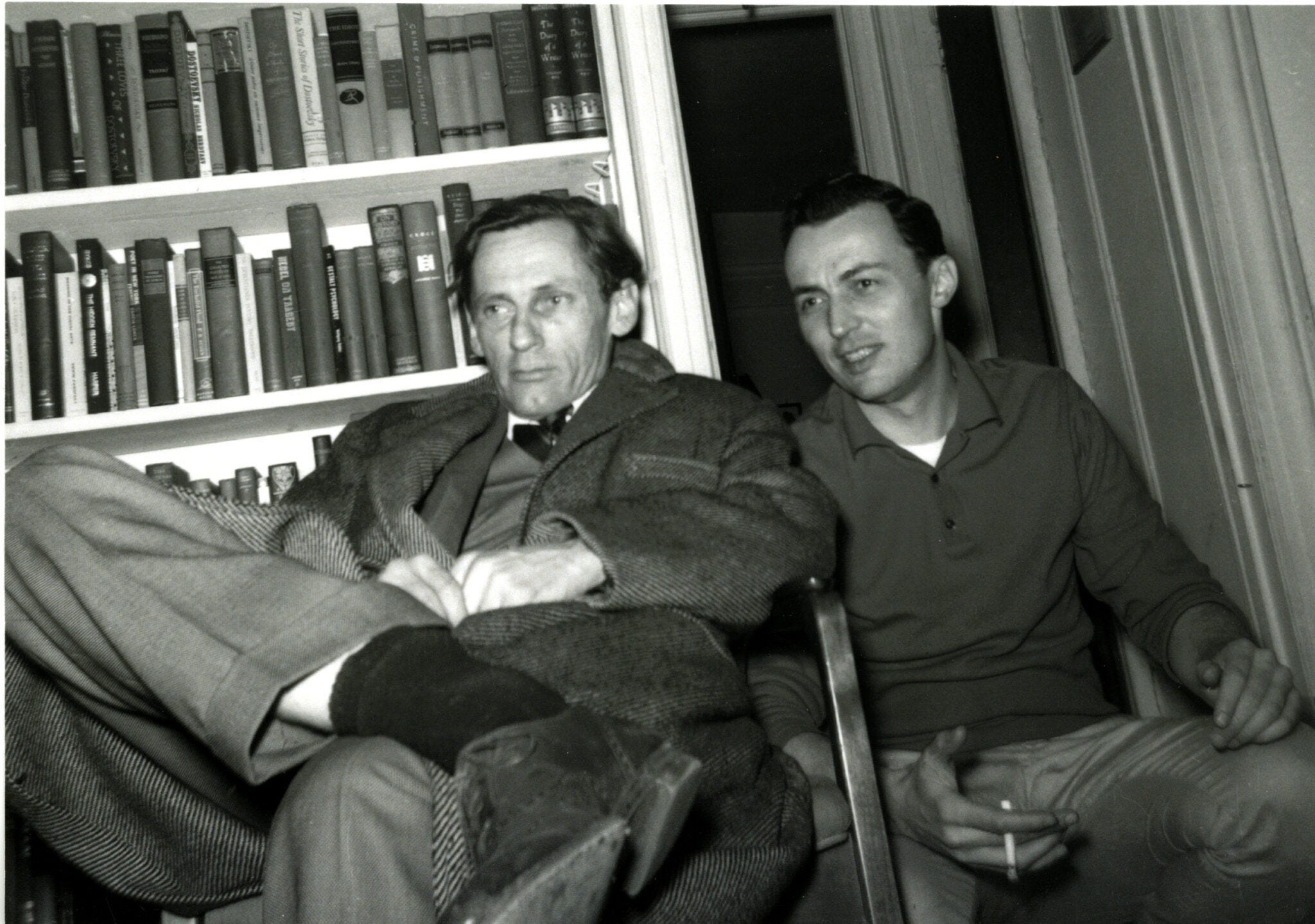
From a 1982 interview in Contemporary Literature:
LeClair: Would you name some writers with whom you have affinities?
DeLillo: This is the great bar mitzvah question. Probably the movies of Jean-Luc Godard had a more immediate effect on my early work than anything I’d read. Movies in general may be the not-so-hidden influence on a lot of modern writing, although the attraction has waned, I think. The strong image, the short ambiguous scene, the dream sense of some moves, the artificiality, the arbitrary choices of some directors, the cutting and editing. The power of images. This is something I kept thinking about when I was writing Americana. This power had another effect. It caused people to walk around all day saying, “Movies can do so much.” It’s movies in part that seduced people into thinking that the novel was dead. The power of the film image seemed to be overwhelming our little world of print. Film could do so much. Print could only trot across the page. But movies and novels are too closely related to work according to shifting proportions. If the novel dies, movies will die with it.
That last line seems like a throwaway, a bit too pat, but considering how bad most movies are nowadays—made by and for nonreaders—I think DeLillo might have been on to something. Narrative art, at least as most people experience it, is sinking further and further into the anoxic slurry of franchises and reboots. Short form video threatens to devour our capacity for all but the most simplistic and derivative storytelling. AI-boosters have been hyping up various text-to-video services, making outsized claims about how “Hollywood is finished” because of vacant reels like, to give a satirical but nonetheless representative example, “Iron Man at Dunder Mifflin”; but as laughable as those claims are they’re also not much of an exaggeration when we think about the culture industry writ large. Just ask a video editor where the jobs are at: feature films or short form content?
For my part, it’s difficult to think of an active filmmaker that has influenced me more than any writer has. I’ve been inspired by aspects of Kiyoshi Kurosawa’s work: his artful but unabashed use of genre forms, his absolute control over the narrative tone, his restrained but nonetheless visceral depictions of violence. But I could also credit the novelist and short story writer Fleur Jaeggy with a similar influence, at least when it comes to tone. As for translation, which is the majority of my published work, I can’t say that any particular filmmaker has influenced me at all. Film images are simply not a useful resource in the mundane activity of rendering a German novel into an English one. Watching Steve Coogan’s adaptation of Tristram Shandy tells me nothing about how to translate Jean Paul Richter, but reading Laurence Sterne, a huge influence on Richter and many other 18th and 19th century German writers, tells me a great deal.
The dominant media forms of today—gaming, live streaming, short form video, et cetera—have little or nothing to offer a writer; the movies of today, much more than in 1982, offer much the same; but I would reject what is often given as a corollary: that writers, especially fiction writers, cannot adequately represent contemporary reality. Such assertions ignore the many 20th century fiction writers— Philip K. Dick, Iain M. Banks, E.M. Forrester, Jorge Luis Borges to name a few—who anticipated systems of infinitely available media and the stultifying effects such systems would have.
Lately I’ve been thinking a lot about JR, William Gaddis’ massive 1975 novel about a child savant—the titular JR—who manipulates the US government and stock market through various investment schemes and shell companies, which he manages via pay phone calls. I’ve never been able to make it more than halfway through, but not due to lack of interest. Life keeps intervening. At some 770 pages (my NYRB Classics edition) it’s a significant investment of time, compounded by the novel being told almost entirely in unattributed dialog. My last readthrough faltered because I needed to finish up with another Jean Paul translation. Somehow that was easier than reading a fellow American who was active during my lifetime.
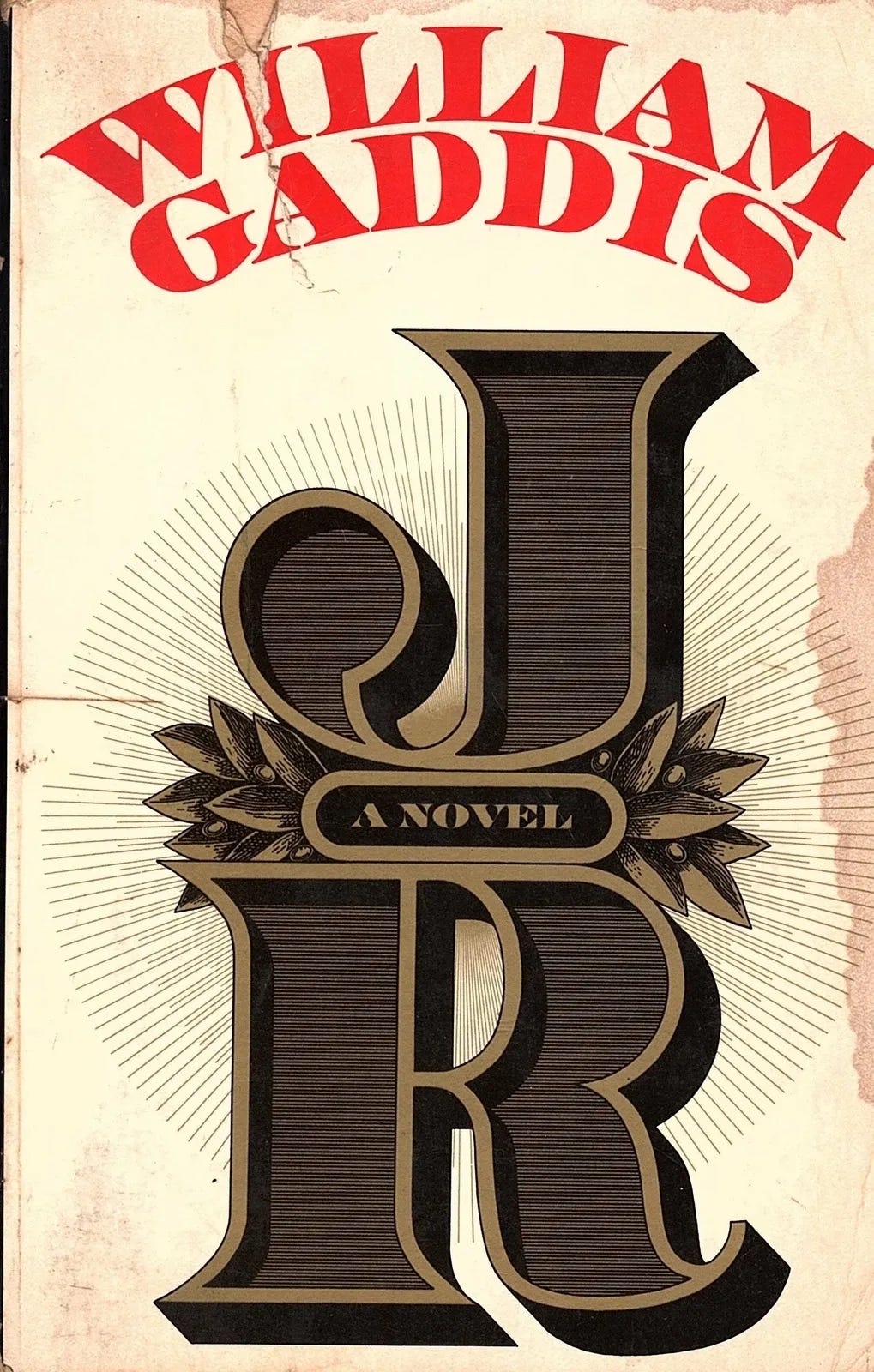
Still, whenever I’m lost trying to think about how to depict reality as it is in 2026, more often than not, instead of borrowing a library Blu-Ray of Kiyoshi Kurosawa or David Cronenberg, I take JR down from a high shelf and wipe the dust from the cover. Despite its midcentury trappings—the TVs, the payphones, the magazines, the money orders—the enervating style and structure of the novel, the dozens of characters who constantly interrupt each other, mishear or deliberately misunderstand each other, and, above all, demonstrate an oceanic level of drooling credulity;—despite me not having read through more than half of that book, I come back from perusing JR confused and humbled but also energized by the plain fact by that AT LEAST SOMEONE COULD COME CLOSE TO DEPICTING HOW CRUEL, HOW GREEDY, AND HOW STUPID THE UNITED STATES IS, a feeling that is counterbalanced by another plain fact: THE UNITED STATES HAS BECOME EVEN MORE CRUEL, EVEN MORE GREEDY, EVEN MORE STUPID THAN GADDIS EVER IMAGINED.
This righteous and necessary condemnation of our culture, difficult to stomach for manifold reasons, is made even more righteous and necessary, and difficult to stomach, because of its messenger. No glib liberal or maladroit leftist, Gaddis was a perpetually embarrassed patrician who understood that America’s cruelty, greed, and stupidity foreclosed the possibility of authentic conservatism, at least a conservatism that upholds dignity, restraint, and the value of tradition in art. Being a child of the 1920s, a time swiftly passing from living memory, It’s difficult to know what Gaddis would have made of the Trump administration, whose senior positions, not even counting the President himself, are filled by television presenters and podcast hosts. It’s difficult to know what he would have made of Elon Musk, who last year, while nodding out on ketamine during a press conference at the White House, showed prominent bruises on his face that he incurred after a fistfight with other members of the Trump administration. It’s difficult to know what Gaddis would have made of so many contemporary developments, but disgust and indignation are, I think, safe bets to make. I wonder if Polymarket has the odds on that.
Much of JR and Gaddis’ subsequent novels were inspired by his day job doing public relations and film production work. He was under no illusions about the nature of that work. While at Pfizer, he wrote to his friend, the novelist David Markson, “I am hung up with an operation of international piracy that deals in drugs, writing speeches on the balance of payments deficit but mostly staring out the window.” It’s a position that a lot of us find ourselves in. The institutions are decayed, criminal in nature. But instead of staring out the window, we stare at our phones, confronted by a legion of hectoring voices, wanting to buy—or buy into—some kind of awful bullshit.